Solo and Duo
The starting point of The Omen comes from very private memories of my childhood. My father is the second son in his family. In my family, he was never the child who received the most attention from my grandparents, and I am his daughter. When I was growing up, I often heard my mother say to me: “Your grandparents don’t like you or your father. Your father is the second son, and you are a girl.” At the time, I could not really understand what this meant. I only knew that I heard it again and again throughout my childhood. My mother was not trying to pass a preference for boys on to me. Quite the opposite. She strongly disliked this kind of unequal treatment. Her anger over these things, accumulated over many years, also became one of the important factors affecting my parents’ relationship later on. As a child, I did not understand why she kept telling me these things. It was only many years later that I gradually began to understand her.
I also have some very specific memories from my own childhood. I studied piano when I was young, and I always wanted very much to have a piano of my own. My grandfather knew this, but he still gave an unused piano in the family to a boy brought into the family by my uncle’s second wife. As a child, I simply could not understand: Why not me? Why, when I wanted that piano so badly and was actually studying the instrument, was it still given to another boy? My grandfather also did not approve of my mother having me study music. He once asked her: “Why are you having a child study this? What do you expect your child to become?” I am not writing these things in order to gain sympathy, nor am I trying to use a piece of music to accuse my family. These things happened. I speak about them simply because, without them, it is difficult to truly explain why The Omen exists.
As a child, I only knew that some things felt unfair. But those experiences remained fragmented in my memory: a sentence, an argument, an expression on someone’s face, a piano that never became mine, or a feeling of anger and sadness that I did not yet know how to explain. It was only after I grew older that I began to look back at these fragments. I gradually realized that some of the questions I once understood only as “Why is my family like this?” were also connected to family structures, gender, and the ways society imagines what a woman should be. Before a girl even knows what kind of life she wants, other people may already have begun imagining it for her: whether she should marry, whether she should become a mother, how she should take care of a family, how she should look, and what kind of woman she should become. Today, many forms of open inequality have become less common than they were in the past. But some pressures have not truly disappeared. They have simply become more hidden. They enter families, language, and the smallest judgments people make about one another. Eventually, they can even enter the way we understand ourselves.
This is also why the sound of the toothbrush remains in the background throughout The Omen. For me, this is very important. The toothbrush does not appear only at certain moments as a symbolic theatrical object held by the performer. Even when it is not directly touching the performer or the viola, its vibration is still there. It is like a background sound that cannot be completely switched off. This is very close to the way I have come to understand these pressures. They do not necessarily do something to you at every moment, but they have existed for such a long time. You can distance yourself from certain things. You can refuse certain expectations. You can find your own way of living. But that does not mean the larger structure disappears. So for me, the question gradually becomes not “How can I make the toothbrush disappear?” but “If it is still there, how am I going to face it?”
The words spoken and the melodies sung by the performer are also almost always broken and fragmented. This is because this is how I understand my own experiences. I did not suddenly grow up one day and suddenly understand everything that had happened in my childhood. I understand something, then question it. I remember something again, then reinterpret it. A memory may mean one thing when I am ten years old, and something completely different when I look back at it many years later. So for me, these fragments are not an abstract compositional technique. They are memory itself. They are also the process of self-reflection itself.
Until the final section, “Who am I? This is a process of finding oneself,” the normal viola bow has not appeared. Only then does it finally enter. Now that I have heard the complete work, I understand this moment differently as well. I used to keep asking: Why? Why did this happen? Why did the fact that I was a girl affect the way other people saw me? Why have these questions, which have been discussed for such a long time, still not completely disappeared? But I am gradually realizing that I may never receive answers to all of these “whys.” So the normal bow at the end no longer means to me that “the problem has been solved.” More importantly, when the normal bow appears, the world represented by the toothbrush still exists. It has not disappeared simply because I have begun to understand myself. The past has not been erased either. But after all the confusion, fragments, and repetition, the viola finally seems to know. It begins to know how to make its own voice heard within all of these sounds that are still present. So for me, the ending is not about escape. It is about facing what is there.
When I was a child, during the moments when I felt overwhelmed by things I could not understand, my greatest comfort, apart from reading, was writing. Later, writing gradually became composition. I have always thought of myself as a realist. I do not want to deliberately avoid my personal experiences in order to make art. The things that once made me confused, angry, or even want to escape are also part of what brought me to where I am today. Discussions about women, gender, and feminism have existed for a long time. I know this is not a new subject. But for me, it has never been only a “subject.” It entered my family. It entered my childhood. It entered my memory. And later, it entered my music. I do not expect you, or anyone who hears or sees this work, to understand my experiences completely. You do not need to have a past like mine. But if a sound, a gesture, an unfinished sentence, or that background vibration that never fully disappears suddenly reminds you of a memory of your own, or of some invisible pressure that once surrounded and affected you but was always difficult to put into words; if, in that moment, you are willing to look at it again—then perhaps that is where I ultimately hope The Omen can arrive.
Lastly, I would like to thank Lorenzo and Maurizio for their guidance and support throughout the development of this work, and Francesca for her wonderful performance. Thank you all for helping bring The Omen to life.
The Omen
(music-theatre)
for viola and electric toothbrush
2026 – San Marino international music summer course and festival
Composed for Francesca Piccioni, viola of the Schallfeld Ensemble
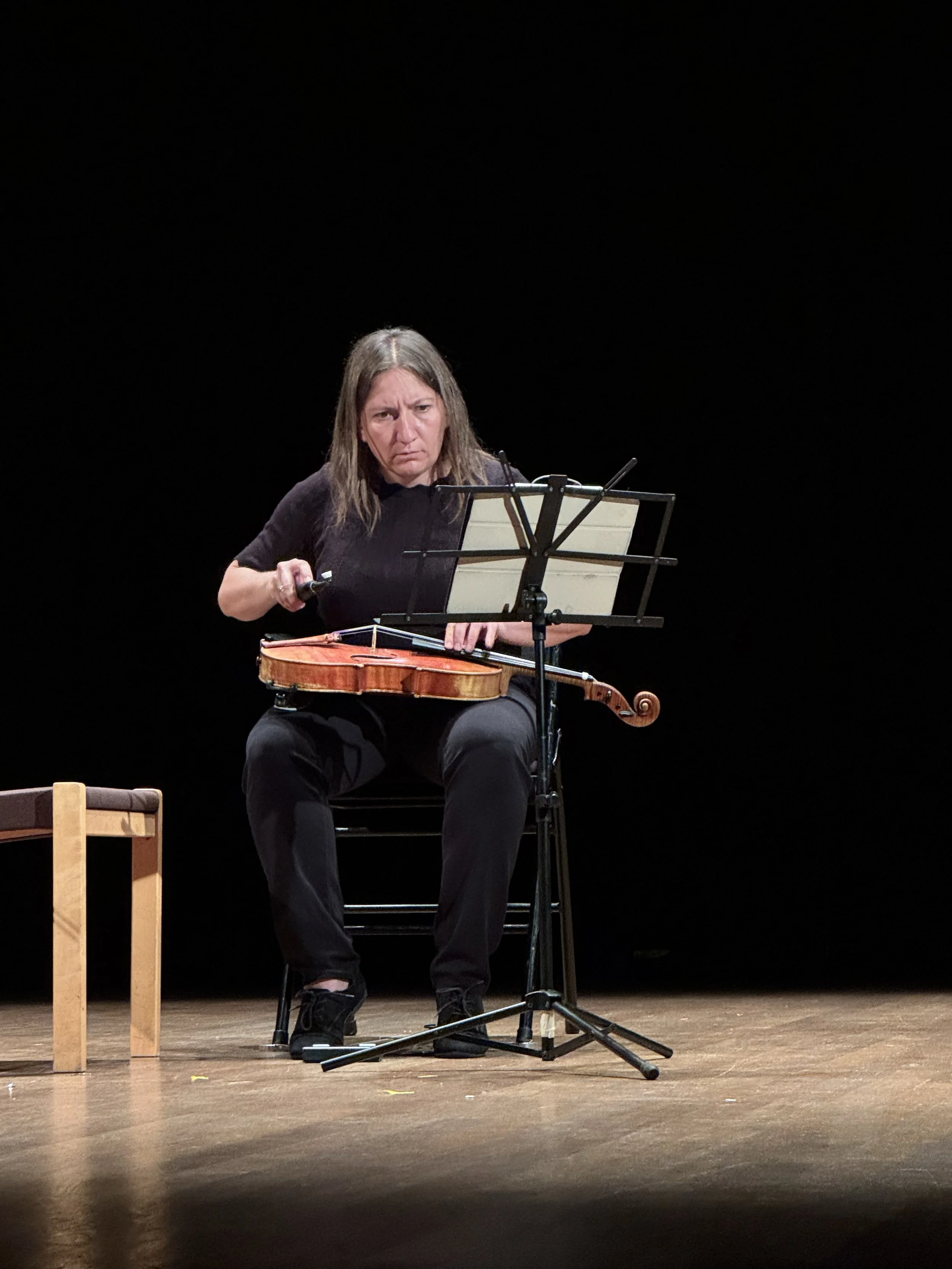
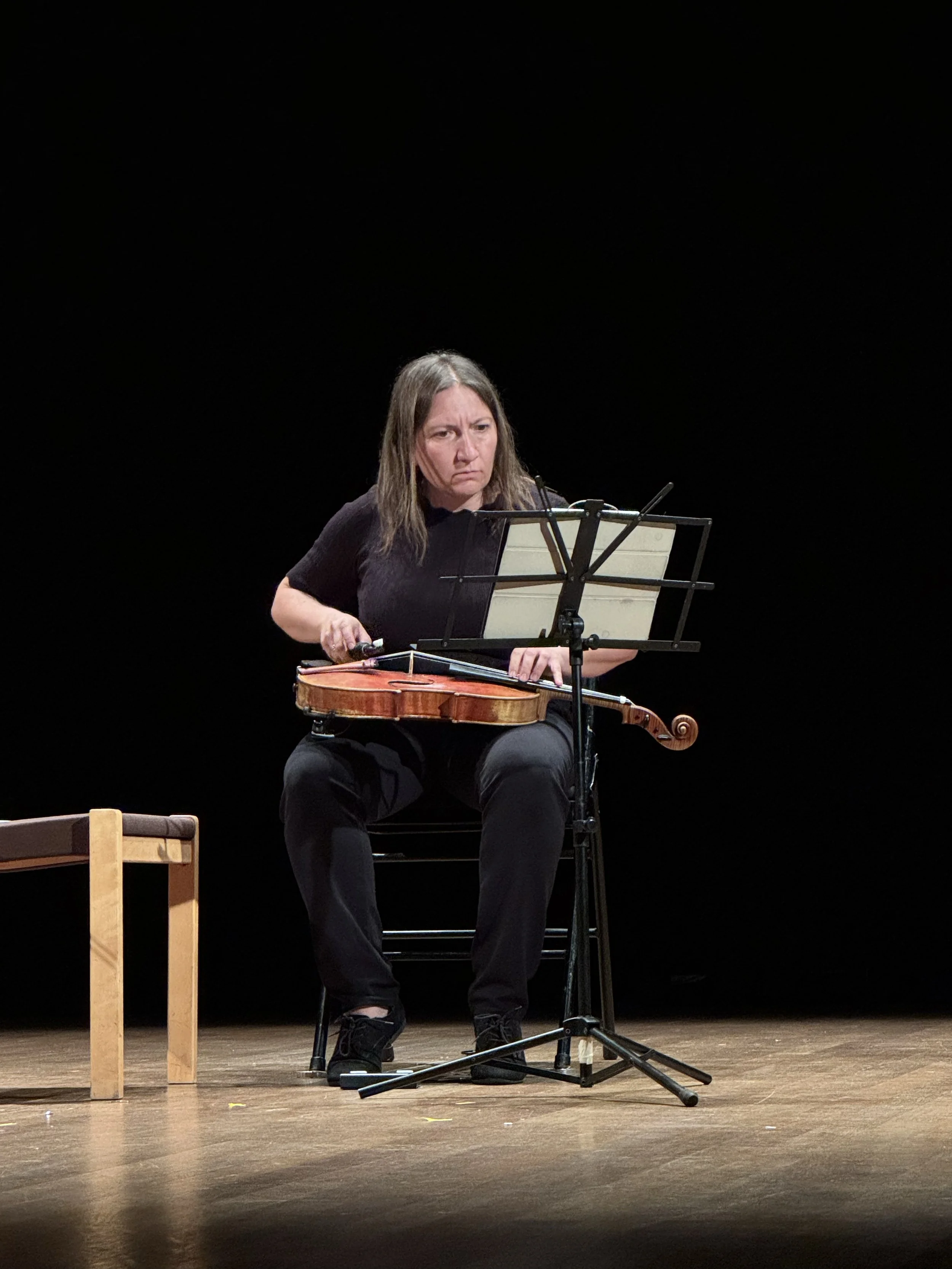
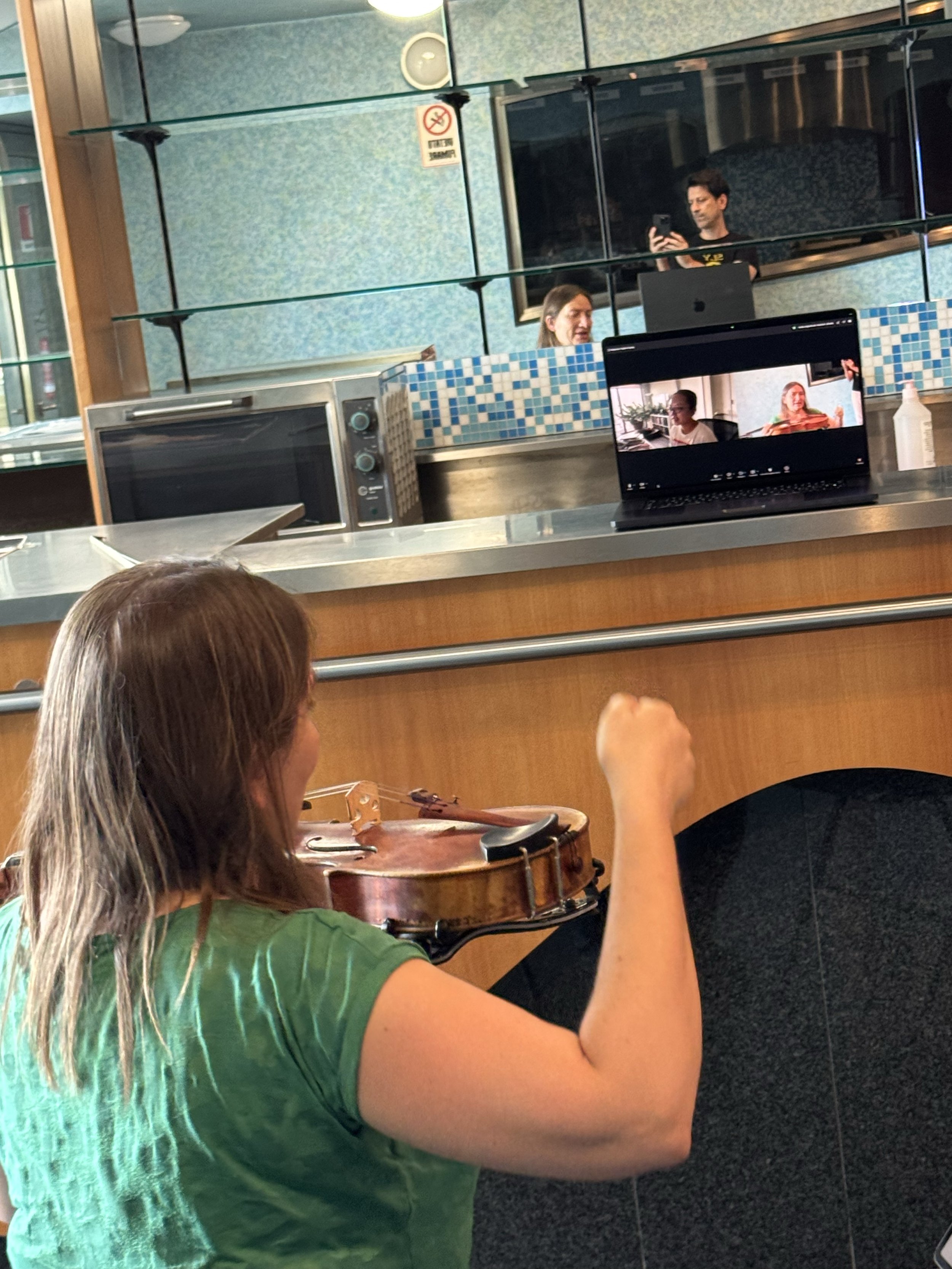
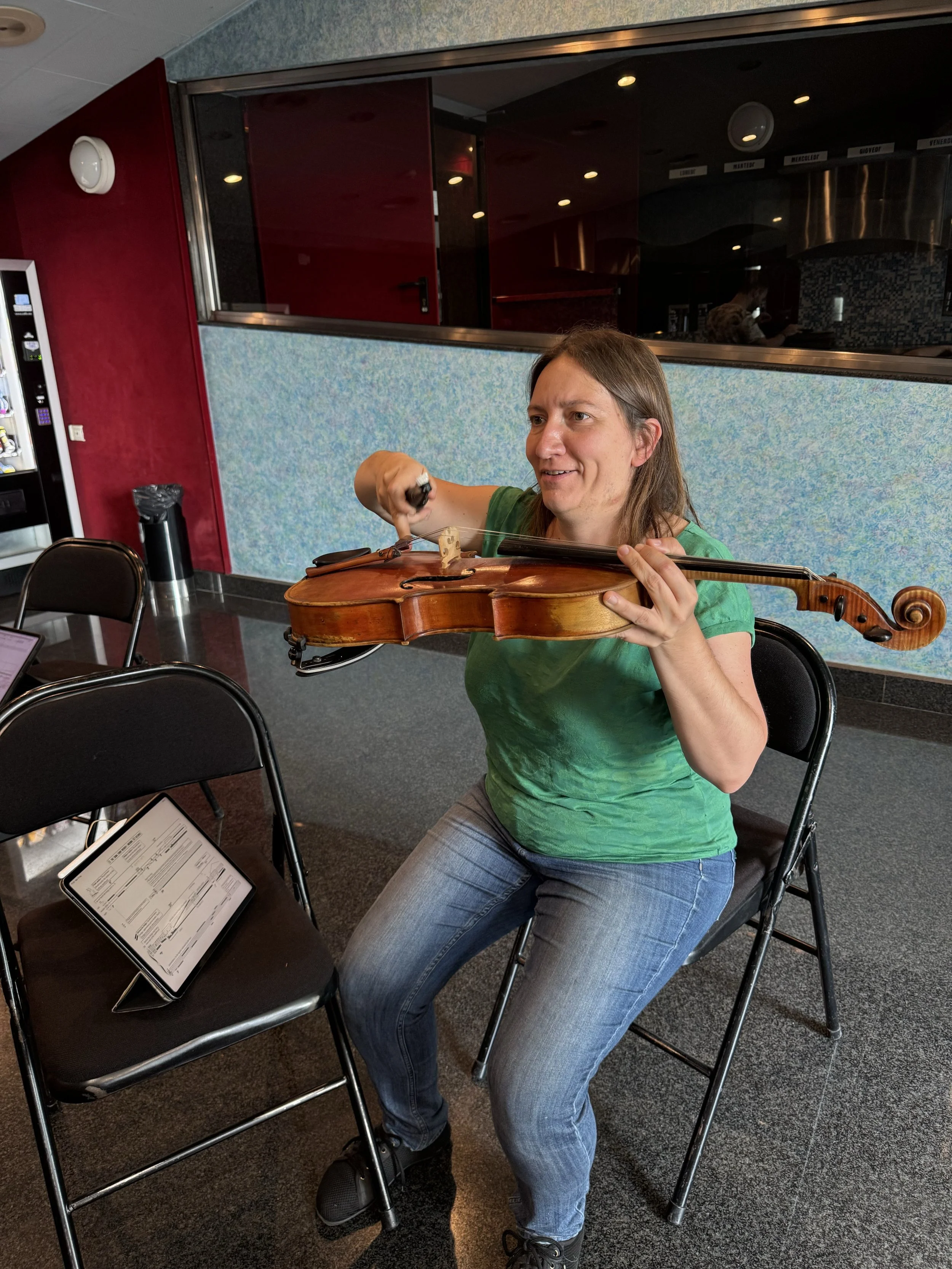
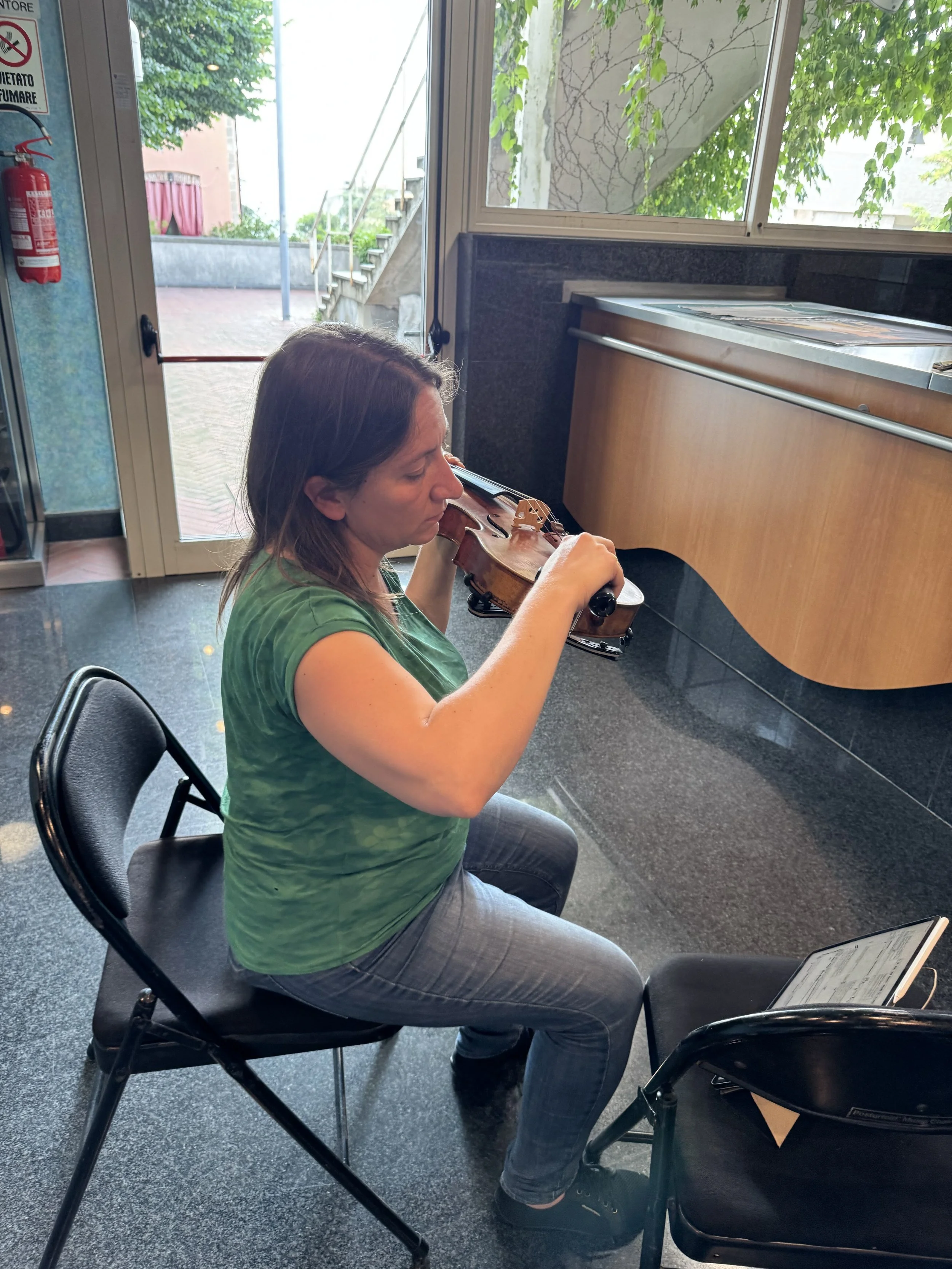
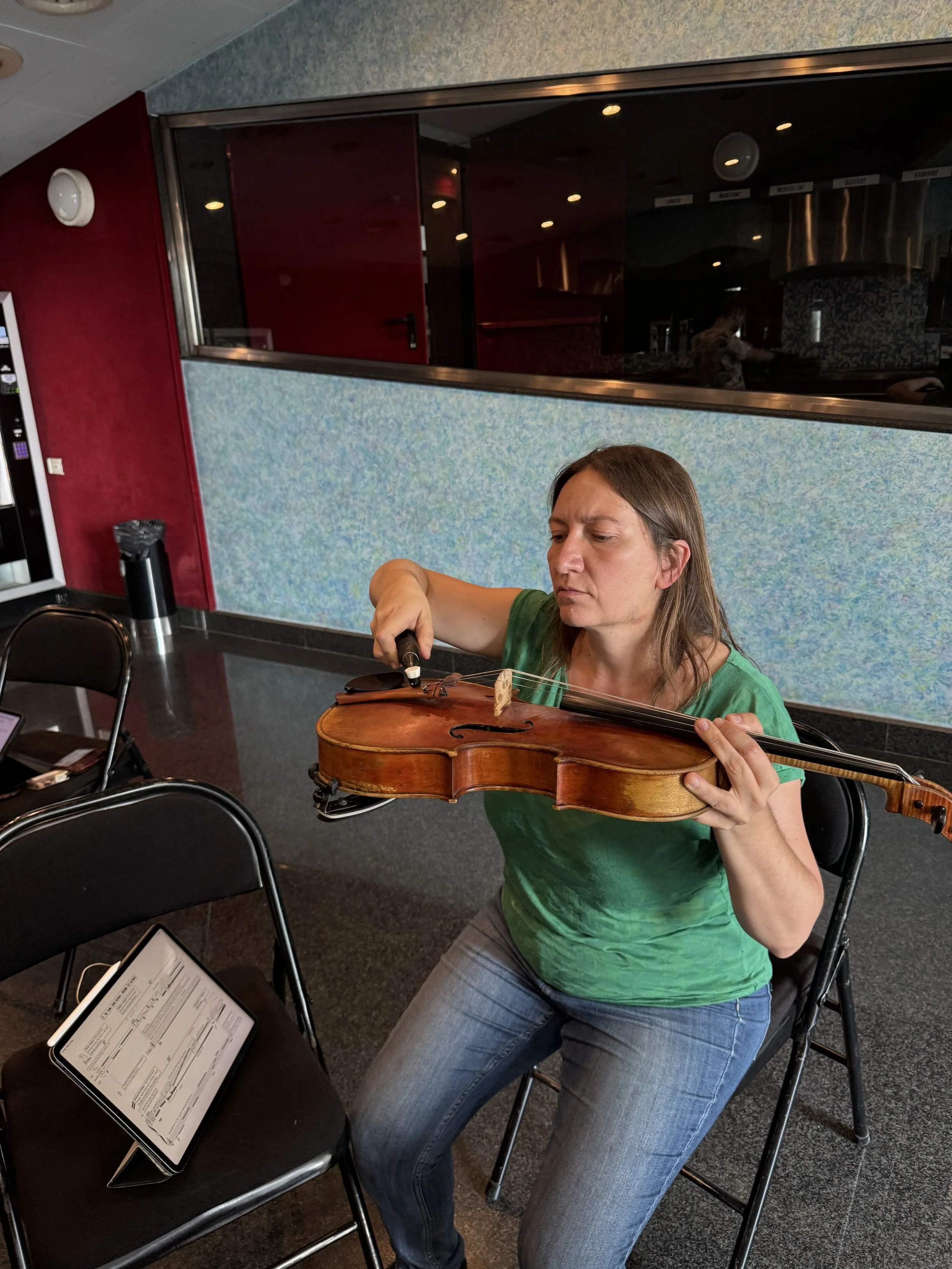
Image source: Lorenzo Pagliei
Lin Chong's Night Escape
for fixed media, video, and piano (2025)
This piece is inspired by the tragic character Lin Chong from the classic Chinese novel Water Margin. The piece is structured in four sections: Prologue, Wrath, Revenge, and Escape, each reflecting a distinct emotional phase of Lin Chong’s journey.
Rather than directly reproducing the despair and betrayal found in the original narrative, I chose to reinterpret the story through sound. By blending cyberpunk textures, 8-bit arcade aesthetics, traditional Chinese operatic percussion, techno, Chiptune, and Black Noise hip-hop, I sought to construct a rhythmically driven, sensory-charged sonic environment. On the surface, the music may feel playful and theatrical, but beneath lies a hidden tragic undercurrent. This duality echoes the old Chinese saying that extreme joy often leads to sorrow. The work is also deeply personal. As a child, I was fascinated by arcade games featuring legendary Chinese heroes like Zhao Yun, Cao Cao, and Guan Yu. The visceral experience of controlling a character in moments of action, escape, and combat left a strong impression on me. When I revisited Lin Chong’s story, that same emotional intensity resurfaced, shaping the sonic imagination of this piece.
2025 – Time of Music (Musiikin aika) Festival, Finland
Lin Chong’s Night Escape premiered at Parish Hall on July 6th (Viitasaari, Finland) by Lis Marti
Wex Huang, Digital Designer
Meeting the Master
for Chinese suona and piano (2024)
This piece is inspired by Mo Yan's short story Meeting the Masters. Using the suona and piano, I tell a story imbued with absurdity, centering on the phenomenon of so-called "masters" in society—those who claim to possess exceptional skills and wisdom but lack moral integrity, yet still manage to attract a large number of blindly devoted followers. The suona, as a traditional Chinese instrument, is renowned for its distinctive timbre and expressive richness, with many of its traditional techniques carrying a strong sense of drama. In this piece, I explore the potential of the suona in contemporary music, pushing the boundaries of its traditional expressive capabilities. For instance, I employ various traditional techniques and the“Ka Xi”technique to imitate human voices, capturing the tone and fervent shouting of fans in their frenzied admiration of the "masters." The sharp and flamboyant sounds of the suona vividly recreate the frenzy and absurdity of blind worship. Meanwhile, the piano engages in an ongoing dialogue with the suona. It not only collaborates with the suona to build the absurd musical atmosphere but also serves as a contrasting character—a calm, resisting voice that stands in opposition to the suona's narrative. I believe that even with just two instruments, it is possible to tell a compelling story.
2025 – Central Chapter Conference
Meeting the Masters premiered at University of Kansas on April 5th (Lawrence, KS) by Kwan Leung Ling and Nichole Ying